The Biblical prophet Isaiah served in the kingdom of Judah during the reign of the kings Uzziah, Jotham, Ahaz and most famously, Hezekiah. Isaiah had messages of judgment to deliver to the inhabitants of Jerusalem and Judah, the kingdom of Israel and the surrounding nations. On occasion, Isaiah’s messages were directed to specific individuals. For example:
“This is what the Sovereign Lord, Jehovah of armies, says: “Go in to this steward, to Shebna, who is in charge of the house, and say, ‘What is your interest here, and who is there of interest to you here, that you hewed out a burial place here for yourself?’ He is hewing out his burial place in a high place; he is cutting out a resting-place for himself in a crag.” (Isaiah 22:15, 16)
So who was Shebna and how did he earn this rebuke? Shebna was “in charge of the house“, that is, he was evidently in charge of the palace of Hezekiah. This was a very prominent position in the kingdom and it placed Shebna in close proximity to the king. Yet, rather than pay attention to his duties to the king and the kingdom, Shebna pursued selfish interests. He built a prominent tomb, a tomb fit for a royal, “in a high place“, highly visible to others.
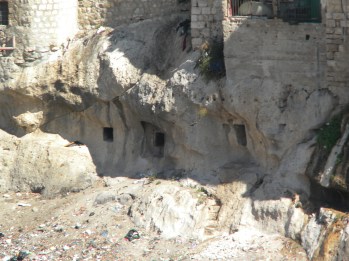 Where was this tomb? The approximate area of the tomb is well known. Only the kings of Judah were buried within the walls of Jerusalem (specifically in the City of David). Everyone else was buried outside of the city. Across the Kidron Valley on the slopes of the Mount of Olives, directly across from the old City of David, generations of aristocratic families carved their burial caves. It seems that aristocrats like Shebna wanted to have their tombs as near as possible to the burial places of the kings.

Ancient tombs beneath Silwan
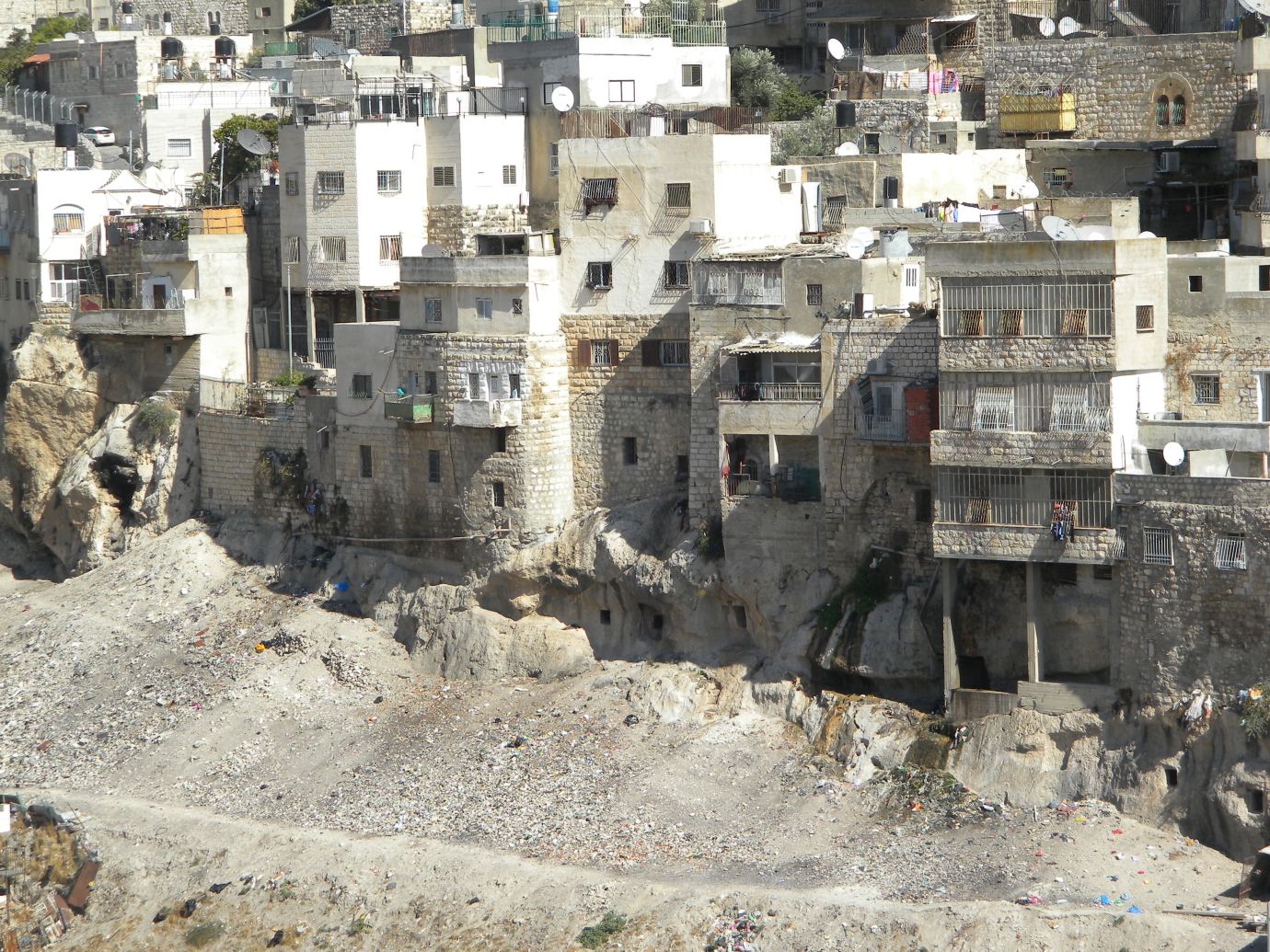
The area where the kingdom of Judah’s aristocratic families preferred to build their tombs has been built over by the Palestinian community of Silwan (see pictures above). This is not new, the community has been there for centuries. Some of the ancient tombs have over time been incorporated into private homes, turned into cellars or used as storage rooms. Archeologists have been able to survey approximately 50 of these ancient tombs in Silwan. Some of these tombs can be easily seen in pictures of the community. The entrance-ways have been carved meticulously, their architectural plans are precise and the stonework is of the highest quality. In a few cases, the tombs still have remnants of ancient Hebrew inscriptions.
In 1870, a French archeologist name Charles Clermont-Ganneau was examining these ancient tombs and surveyed a partially destroyed tomb in Silwan located high up on a cliff. There, Clermont-Ganneau discovered an inscription that he was unable to decipher so he cut it out of the rock and sent it to the British Museum in London (where it remains to this day). Part of the inscription is lost to us. What could be recovered reads: This is [the grave of] [… …]yahu, who is over the house. There is no silver or gold here, only … [his bones] … and the bones of his maidservant with him. Cursed be the man who opens this.”
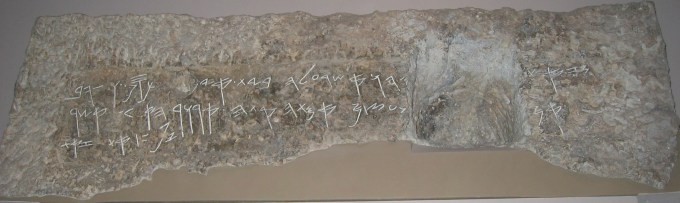
The partially destroyed inscription from the tomb in Silwan.
Unfortunately, the name is partially destroyed but what has survived is informative. Names ending “iahu” or “yahu” are called “theophoric” names. Theophoric names embed the name of a god, or in this case, the name of the one true God. In Hebrew the name of God was spelled with the 4 consonants, YHWH. The vowel sounds have been lost to us but some scholars believe that the name may have been pronounced Yahweh while others favour the pronunciation Yahowah or Yahovah (commonly pronounced Jehovah in English). The shortened form of the name is Yah or Jah. That is what is included in the theophoric ending of this name. A persons name could be spelled with or without the theophoric ending. So the question is, what was the first part of the name from the inscription, the part that was destroyed?
In an 1953 article in a archeological journal¹, a prominent epigraphist (Epigraphy is the study of inscriptions, especially ancient inscriptions) named Nahman Avigad convincingly demonstrated that the name on the inscription originally read “Shebnayahu”, and referred to the same Shebna who was over King Hezekiah’s palace. The name fits perfectly into the missing area of the inscription, better than any of the alternative names that had theophoric endings that Avigad tried. Today this conclusion is widely (although not universally) accepted.
Avigad compared the tombs inscription with the writing found on the wall of Hezekiah’s tunnel. By comparing the letters and writing styles of the inscription found in the tomb with those found in the tunnel, he established that both were written during the reign of King Hezekiah. So the timing is right, but is there any evidence that Shebna ever used the theophoric name Shebnayahu?
Two clay “bullae” or clay seals have been discovered that contain the name Shebnayahu. One of these official seals was discovered in Lachish, which had been the second most important city in the kingdom of Judah. Several lines of evidence from the excavation lead to the conclusion that the clay seal is contemporaneous with the inscription in Hezekiah’s Tunnel and the inscription over the entrance to Shebna’s tomb. Unfortunately the clay seal has degraded over time and it is impossible to read the entire impression beyond the name Shebnayahu.
The second seal with the name Shebnayahu was discovered in an antiquities market in 2007. This bullae was clearly impressed by the same seal. When the two seals are combined it is possible to read the entire impression. It reads, “Shebnayahu servant of the king”. So we have a royal official named Shebnayahu who was contemporaneous with King Hezekiah and the prophet Isaiah who seems to have sent an official letter from King Hezekiah’s court, sealed it with his personal stamp and sent it to an official at Lachish. The Bible account shows that although Shebna was stripped of his role as palace steward after Isaiah’s reproof, he remained in the kings service. Years later when the Assyrian spokesman demands Jerusalem’s surrender, Hezekiah’s new palace steward Eliakim goes out to meet him. Eliakim does not go alone, Shebna is at his side as secretary to the king. (Isaiah 36:22) So it is no surprise that official correspondence from Shebna should be found in Lachish.
Today the tomb where the inscription was discovered still exists but it too has been incorporated into one of the homes in Silwan. Regarding Shebna, we don’t know how the prophecy concerning him was fulfilled.
“‘Look! Jehovah will hurl you down violently, O man, and seize you forcibly. He will certainly wrap you up tightly and hurl you like a ball into a wide land. There you will die, and there your glorious chariots will be, a disgrace to your master’s house. And I will depose you from your position and throw you out of your office.” (Isaiah 22:17-19)
It may have been that Shebna learned his lesson, changed his ways and that God in his mercy spared Shebna the calamitous end that had been prophesied. Or if Isaiah 22: 17-19 was fulfilled literally than Shebna was eventually exiled to a foreign land, never to return. If that was the case, then the grand tomb outside of Jerusalem was never even occupied by Shebna. It may have become the tomb of someone else or even remained empty, a reminder of the folly of pride and vanity.
References:
¹ Nahman Avigad, “The Epitaph of a Royal Steward from Siloam Village,” Israel Exploration Journal 3 (1953), pp. 137–152, Pls. 8–11.
Image Credits:
Silwan Inscription. (CC BY-SA 3.0) Wikimedia Commons
All other photos by the author.
 Bible Reading Archeology

One thought on “Has The Tomb of Shebna Been Discovered?”